Last Updated: 27 November, 2025
With decades of combined experience in cataract and refractive surgery, Dr Parth Shah, a leading ophthalmologist in Canberra, has successfully restored clear vision for thousands of patients.
Known for his precision, patient-centred approach, and use of the latest surgical technology, Dr Shah provides personalised guidance to help patients choose the right intraocular lens (IOL) for their visual needs. This blog explains the differences between monofocal, multifocal, and toric lenses, helping patients make an informed decision with confidence.
What are the different lens options available in cataract surgery?
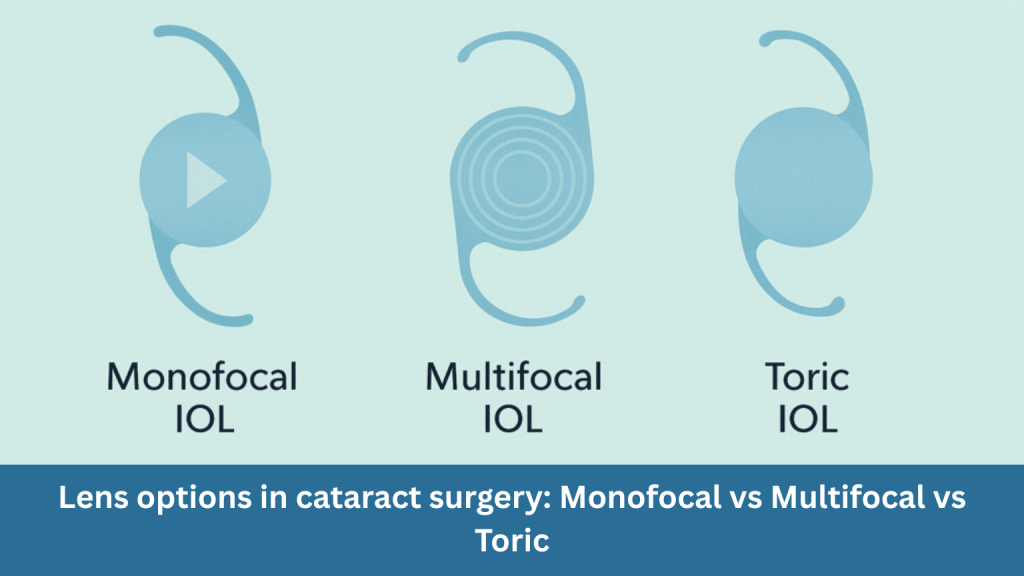
During cataract surgery, the eye’s cloudy natural lens is replaced with a clear artificial intraocular lens (IOL). The choice of lens determines how well a person can see at different distances after surgery. The three main options are:
- Monofocal lenses – provide clear vision at one fixed distance (usually for distance vision).
- Multifocal lenses – designed to correct both near and distance vision, reducing dependence on glasses.
- Toric lenses – correct astigmatism and can also be monofocal or multifocal depending on patient needs.
Each lens type has unique benefits, and the choice depends on individual lifestyle, vision goals, and eye health.
What is a monofocal lens and who is it best for?
A monofocal lens offers clear vision at one focal point—typically for distance. Patients may still require reading glasses for near tasks such as using a phone, reading, or sewing.
Best suited for:
- Patients prioritising clear distance vision.
- Those comfortable using glasses for near work.
- People with other eye conditions where advanced lenses may not be suitable.
Advantages:
- Excellent visual clarity and contrast.
- Lower cost compared to premium lenses.
- Reliable and predictable visual outcomes.
Considerations:
Monofocal lenses do not eliminate the need for glasses altogether. However, some patients may opt for monovision correction, where one eye is set for distance and the other for near vision, offering a balance between clarity and independence from glasses.
How does a multifocal lens work and what are its benefits?
Multifocal lenses are advanced IOLs that contain different zones or rings to focus light from various distances. They provide a broader range of vision—distance, intermediate (computer use), and near—minimising the need for glasses.
Best suited for:
- Active individuals who wish to reduce or eliminate dependence on spectacles.
- Those who frequently drive, travel, or use digital devices.
Advantages:
- Clear vision at multiple distances.
- Greater independence from glasses for most activities.
- Enhanced quality of life and visual freedom.
Considerations:
Some patients may experience mild glare or haloes around lights at night, particularly during the adjustment period. Careful pre-operative assessment and patient selection help minimise these effects.
What is a toric lens and how does it help astigmatism?

A toric lens is specifically designed to correct astigmatism, a condition where the cornea has an irregular shape causing blurred or distorted vision. Toric IOLs neutralise this irregularity, delivering sharper, more focused vision.
Best suited for:
- Patients with moderate to significant corneal astigmatism.
- Individuals who want clearer distance or multifocal vision without glasses.
Advantages:
- Corrects astigmatism effectively.
- Provides clearer, sharper visual quality.
- Reduces the need for glasses for distance or near tasks depending on the lens design.
Considerations:
Precise measurements and accurate alignment during surgery are crucial for optimal outcomes. Dr Shah uses advanced diagnostic imaging and precision marking systems to ensure each toric lens is positioned accurately.
Which lens type is right for you?
Choosing the right lens depends on several factors, including:
- Lifestyle: Whether the patient prioritises distance, near, or all-range vision.
- Occupation and hobbies: Reading, driving, sports, or computer use may influence lens selection.
- Existing eye health: Conditions such as macular degeneration or corneal irregularities may limit the suitability of advanced lenses.
- Visual expectations: Some patients prefer absolute clarity at one distance, while others desire maximum freedom from glasses.
What should you expect after cataract surgery with these lenses?
Recovery from cataract surgery is typically quick. Most patients notice improved vision within a few days, with full stabilisation in a few weeks. Regardless of the lens type, following post-operative care instructions and attending scheduled follow-up visits are key to achieving the best results.
- With monofocal lenses: Expect sharp distance vision but continued use of reading glasses.
- With multifocal lenses: Expect greater freedom from glasses and clear vision across multiple distances.
- With toric lenses: Expect sharper, astigmatism-free vision with reduced visual distortion.
Conclusion
Each lens option—monofocal, multifocal, or toric—offers distinct advantages depending on a patient’s vision goals, eye health, and lifestyle. Selecting the right lens is a personalised decision that can greatly impact long-term visual comfort and quality of life.
With his extensive experience, advanced surgical expertise, and commitment to precision eye care, Dr Parth Shah ensures every patient receives the most suitable and effective lens option for their unique needs.
If you are considering cataract surgery and want clear, confident vision tailored to your lifestyle, book a consultation with Dr Parth Shah in Canberra today to discuss the best lens choice for you.
Author bio
Dr Parth Shah is a leading ophthalmologist in Canberra, specialising in cataract surgery. With extensive training and experience, he is renowned for his expertise in the field. Dr Shah is dedicated not only to performing successful surgeries but also to patient education. His compassionate approach, combined with technical proficiency, has earned him the trust and gratitude of countless patients. He is a true advocate for eye health and a trusted name in the Canberra ophthalmology community.
FAQs