Last Updated: 14 October, 2025
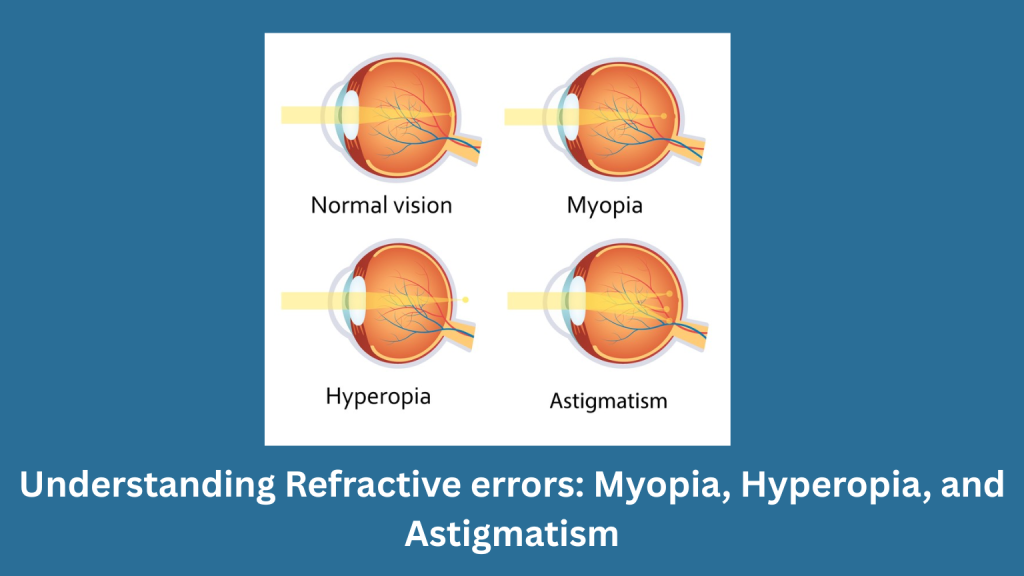
Good vision is something most of us take for granted—until we begin to notice blurred vision, eye strain, or headaches. Often, these issues are linked to refractive errors, the most common vision problems worldwide. Refractive errors occur when the eye cannot properly bend (refract) light to focus it on the retina, resulting in blurred or distorted vision.
In this blog, we will explore the three most common refractive errors—myopia (short-sightedness), hyperopia (long-sightedness), and astigmatism—their causes, symptoms, and treatment options.
What are refractive errors?
Refractive errors happen when the shape of the eye prevents light from focusing directly on the retina. Normally, light passes through the cornea and lens to form a sharp image. However, if the eye is too long, too short, or the cornea has an irregular curvature, light focuses incorrectly, leading to blurred vision.
Refractive errors are not a disease but rather a common eye condition that can be corrected with glasses, contact lenses, or surgery.
Myopia (Short-sightedness)
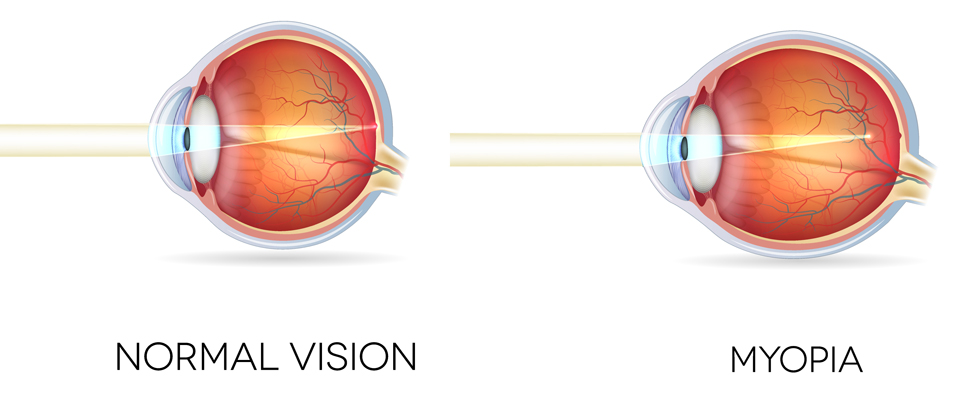
Myopia is when distant objects appear blurry, while close objects are clear. It occurs because the eyeball is slightly longer than normal or the cornea is too curved, causing light to focus in front of the retina.
Common symptoms:
- Difficulty seeing distant objects. (e.g., road signs, classroom boards)
- Squinting or eye strain.
- Headaches from straining to see clearly.
Risk factors:
- Family history of myopia.
- Prolonged near work. (reading, computer use, smartphones)
- Limited time spent outdoors in childhood.
Treatment:
- Glasses or contact lenses: The simplest and most common correction.
- Orthokeratology (Ortho-K): Special rigid contact lenses worn overnight to temporarily reshape the cornea.
- Laser eye surgery (e.g., LASIK, PRK, SMILE): Permanent reshaping of the cornea to reduce or eliminate the need for glasses.
Hyperopia (Long-sightedness)
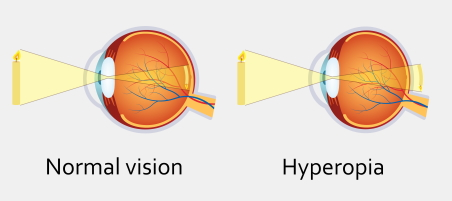
Hyperopia occurs when close objects are blurry, while distant vision may remain clear. It happens when the eyeball is shorter than normal or the cornea is too flat, so light focuses behind the retina.
Common symptoms:
- Difficulty focusing on close tasks E.g. reading, sewing or using a phone.
- Eye strain or fatigue, especially after close work.
- Headaches
- In children, crossed eyes (strabismus) may develop if hyperopia is untreated.
Risk factors:
- Genetic predisposition.
- Age—hyperopia can become more noticeable with time as the natural lens loses flexibility.
Treatment:
- Glasses or contact lenses: Lenses help focus light correctly on the retina.
- Laser eye surgery: Alters the corneal shape to improve focus.
- Lens implants: In severe cases, an artificial intraocular lens may be used.
Astigmatism
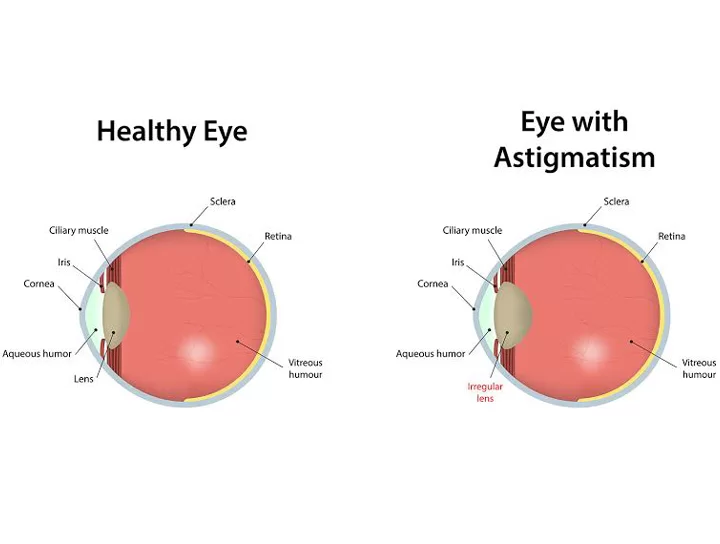
Astigmatism is caused by an irregularly shaped cornea or lens, which prevents light from focusing evenly on the retina. Instead of being perfectly spherical, the cornea is shaped more like a rugby ball, leading to distorted or blurred vision at all distances.
Common symptoms:
- Blurred or distorted vision.
- Difficulty seeing clearly at night.
- Squinting.
- Eye strain and headaches.
Risk factors:
- Can occur at birth. (congenital)
- May develop after an eye injury or surgery.
- Often occurs alongside myopia or hyperopia.
Treatment:
- Glasses or contact lenses: Cylindrical lenses are used to correct the irregular focus.
- Toric contact lenses: Specially designed for astigmatism.
- Laser surgery: Reshapes the cornea for clearer vision.
Regular eye checks matter
Many refractive errors are first noticed during childhood, but they can develop or worsen in adulthood. Regular eye examinations are essential, even if you do not have obvious symptoms. Optometrists in Australia recommend:
- Every 2 years for adults with no vision problems.
- Every 1 year for those with existing eye conditions, diabetes, or a family history of eye disease.
- Every 1–2 years for children, especially during school years, to catch early vision problems that may affect learning.
Living with refractive errors
With today’s advanced technology, managing refractive errors is easier than ever. Glasses and contact lenses provide safe and effective correction, while surgical options can offer long-term freedom from eyewear. Importantly, untreated vision problems can affect daily life, learning, and even safety, such as driving.
Conclusion
Refractive errors such as myopia, hyperopia, and astigmatism are among the most common causes of vision problems, yet they are also some of the most treatable. These conditions can affect daily activities—whether it is reading, driving, studying, or working on digital devices—but with the right care, they do not have to limit your quality of life.
Early detection is key. Many people adjust to blurred or strained vision without realising there is an underlying issue, which can delay treatment and impact long-term eye health. Regular eye examinations ensure problems are identified early, giving you access to effective solutions like glasses, contact lenses, or advanced surgical options tailored to your needs. Take the first step towards better vision today. Book a consultation with Dr Parth Shah, a trusted ophthalmologist, who offers personalised care and advanced treatment options for all types of refractive errors. With his expertise, you can gain not just clearer sight, but also peace of mind about your eye health.
Author bio
Dr Parth Shah is a leading ophthalmologist in Canberra, with a special interest in paediatric eye surgery. With extensive training and experience, he is renowned for his expertise in the field. Dr Shah is dedicated not only to performing successful surgeries but also to patient education. His compassionate approach, combined with technical proficiency, has earned him the trust and gratitude of countless patients. He is a true advocate for eye health and a trusted name in the Canberra ophthalmology community.