Table of Contents
ToggleLast Updated: 22 May, 2025
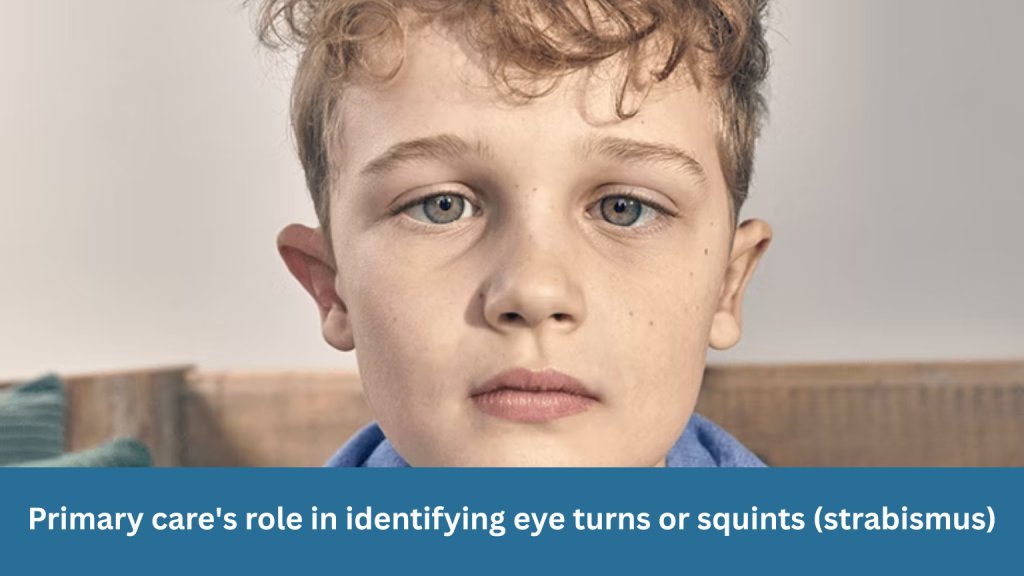
Strabismus, commonly known as an eye turn or squint, is a condition where the eyes do not align properly. While one eye may look straight ahead, the other may turn inward, outward, upward, or downward. This misalignment can be constant or intermittent and may affect one or both eyes.
Early identification and intervention are critical to preventing long-term vision problems such as amblyopia (lazy eye) or permanent visual impairment. This is where primary care providers, including general practitioners (GPs) and paediatricians, play a crucial role.
What is strabismus?
Strabismus is a visual disorder where the eyes fail to maintain proper alignment and coordination. It can present in several forms:
- Esotropia – inward turning of the eye.
- Exotropia – outward turning of the eye.
- Hypertropia – upward deviation.
- Hypotropia – downward deviation.
Strabismus can be congenital (present at birth) or develop later in life due to trauma, neurological issues, or untreated vision problems.
Why primary care matters in early detection?
Primary care professionals are often the first point of contact for families, especially during routine health check-ups for infants and children. This provides a valuable opportunity to identify early signs of strabismus and refer patients for specialised eye care.
Key responsibilities include:
1. Routine vision screening
During wellness visits, especially in pediatric care, routine eye exams help identify early signs of misalignment. These screenings should include:
- Red reflex testing.
- Corneal light reflex test (Hirschberg test).
- Cover/uncover test.
2. Parental guidance
Parents may not recognise subtle eye misalignment. GPs and pediatricians can educate them on warning signs, such as:
- One eye appearing misaligned or “lazy”.
- Eye drifting while focusing.
- Children tilting their heads to see clearly.
- Squinting or closing one eye in bright light.
3. Monitoring high-risk groups
Children with a family history of strabismus, premature birth, or developmental delays are at a higher risk or strabismus. Primary care providers must remain vigilant during check-ups.
4. Timely referrals
If strabismus is suspected, a prompt referral to an optometrist or ophthalmologist is essential. Early treatment increases the chances of full vision correction and prevents complications like amblyopia.
Signs and Symptoms to watch for
Whether you are a parent or a primary care professional, it is important to recognise the symptoms of strabismus:
- Crossed or wandering eye.
- Double vision (in older children and adults).
- Head tilting or turning.
- Poor depth perception.
- Frequent eye rubbing or squinting.
Diagnostic tools in primary care
While a definitive diagnosis should be made by an eye specialist, primary care providers play a crucial role in early detection. They can perform a few simple, non-invasive tests to screen for common eye problems, especially in children. These include:
Visual acuity test – Adapted for age
This test checks how clearly each eye sees at distance. For adults and older children, a standard Snellen chart is used, while picture or symbol charts are used for younger children. Any vision below the expected level for age may indicate the need for glasses or further eye evaluation.
Hirschberg test – Assesses light reflection in pupils
This quick screening helps detect misalignment of the eyes (strabismus). A penlight is shone at both eyes, and the reflection of the light on the corneas is observed. If the light is not centered in both pupils, it may suggest an eye turn.
Cover test – Detects hidden eye turns
This test identifies both visible and hidden eye misalignments. The patient focuses on an object while one eye is covered. If the uncovered eye moves to refocus, it indicates a possible deviation. This test helps detect conditions like esotropia (inward turn) or exotropia (outward turn).
Any abnormal findings during these initial screenings should lead to prompt referral to an optometrist or ophthalmologist for further evaluation and treatment. Early detection in primary care can prevent long-term vision problems, especially in young children.
Treatment options after referral
- Glasses or Contact lenses: Used to correct refractive errors and help align the eyes in certain types of strabismus. Especially effective in accommodative cases.
- Patching therapy for amblyopia: Covers the stronger eye to stimulate and strengthen vision in the weaker eye, improving overall eye function.
- Botox injections: Temporarily weakens overactive eye muscles to improve alignment without surgery, however, is only suitable for select cases.
- Surgical correction: Involves repositioning eye muscles to achieve proper alignment, improving both appearance and visual function.
Early detection by primary care professionals can reduce the need for invasive treatment and significantly improve visual outcomes.
Conclusion
Strabismus is a common yet often overlooked eye condition that can lead to serious vision problems if left untreated. Primary care providers, especially general practitioners and paediatricians, are in a unique position to identify early signs of misalignment during routine check-ups. By performing simple screening tests, educating parents, and promptly referring suspected cases to eye care specialists, they play a pivotal role in ensuring timely intervention. Early detection and treatment can greatly enhance visual outcomes, reduce the risk of amblyopia, and support healthy vision development in children.
Author bio
Dr Parth Shah is a leading ophthalmologist in Canberra, specialising in eye muscle surgery. With extensive training and experience, he is renowned for his expertise in the field. Dr Shah is dedicated not only to performing successful surgeries but also to patient education. His compassionate approach, combined with technical proficiency, has earned him the trust and gratitude of countless patients. He is a true advocate for eye health and a trusted name in the Canberra ophthalmology community.
FAQs
In some very mild or intermittent cases, especially in infants, strabismus may resolve naturally. However, persistent or worsening misalignment usually requires treatment. Regular monitoring by a healthcare provider is essential.
Eye alignment can be screened at birth and during early infant check-ups, with formal vision screenings recommended by age 3 to 5 years. Earlier if risk factors or symptoms are noticed.
Some forms of strabismus, especially intermittent or small-angle deviations, may be very subtle and hard for parents to detect. This is why professional screenings are important even when no obvious signs are present.
Yes, strabismus can develop in adulthood due to factors like neurological issues, trauma, thyroid eye disease, or stroke. Adults with new-onset strabismus should seek prompt evaluation.
Strabismus is a misalignment of the eyes, while amblyopia is reduced vision in one eye due to lack of proper visual stimulation. Strabismus can cause amblyopia if untreated.
While most cases are due to genetic, neurological, or developmental factors, uncorrected refractive errors or poor visual habits may contribute in some cases. Regular eye care helps prevent complications.
Excessive screen time does not directly cause strabismus, but it may worsen existing eye coordination issues or delay diagnosis if a child avoids looking at far distances.
Occasional eye turns during fatigue or illness may be benign, but if the behaviour persists or increases in frequency, an eye exam is recommended to rule out underlying strabismus.